
Monthly
Twelve issues a year. It’s the cadence that turns into a habit on the reader’s side, and it’s what most clients settle on once the first few are out.
Email & digital
The same issue we’d have printed, sent as an email and published as a flipbook you can link to and share. No print, no postage, and no two-week lead time.
Direct mail to a house list responds at around 9%, against roughly 1% for email to a cold list.
ANA / DMA Response Rate ReportWinning a new client costs many times what keeping an existing one does.
Harvard Business Reviewof B2B marketers use email newsletters as part of their content marketing.
Content Marketing InstitutePublished industry benchmarks, not our clients' results. Outcomes vary by market and list — we don’t promise numbers before we’ve seen yours.
Nothing is cut to make this the lower price. Same interview, same articles, same masthead, same schedule. What comes off is the paper, the postage and the lead time — and what you get back is speed. It goes out the day you sign it off, and it forwards in a way paper never has: one click and a partner at another firm is reading your column.
You also find out what happened. Who opened it, what they clicked, how far into the flipbook they got. Paper tells you none of that. The honest trade is attention — a mailed piece gets more of it per send, and an email has to earn its open every single time. That’s the deal: less attention, far less cost, and it lands immediately.
What you get
Nothing here is an upsell waiting to happen. This is the scope.
The twenty-minute interview, the articles and your masthead, unchanged. This is the print issue without the printing, not a shorter version of it.
Set for a small screen first, and still legible with images switched off — which is how a fair number of people will see it.
A page-turning digital edition at a URL you can email, text, put in a signature or drop on your site. It reports how far people read and what they clicked.
Authentication set on your domain before the first send, so mailbox providers can verify the mail is really from you.
An unsubscribe honored immediately, and the spam-complaint rate watched issue to issue rather than after something breaks.
Opens, clicks, replies, unsubscribes and which article did the work. If an issue landed flat, we say so and change the next one.
What arrives
The same issue arrives as an email and as a flipbook you can link to. No printing, no postage, and it lands the day it ships.
The link works anywhere — a text message, a signature, a follow-up to somebody who asked what you do. Paper cannot be forwarded.
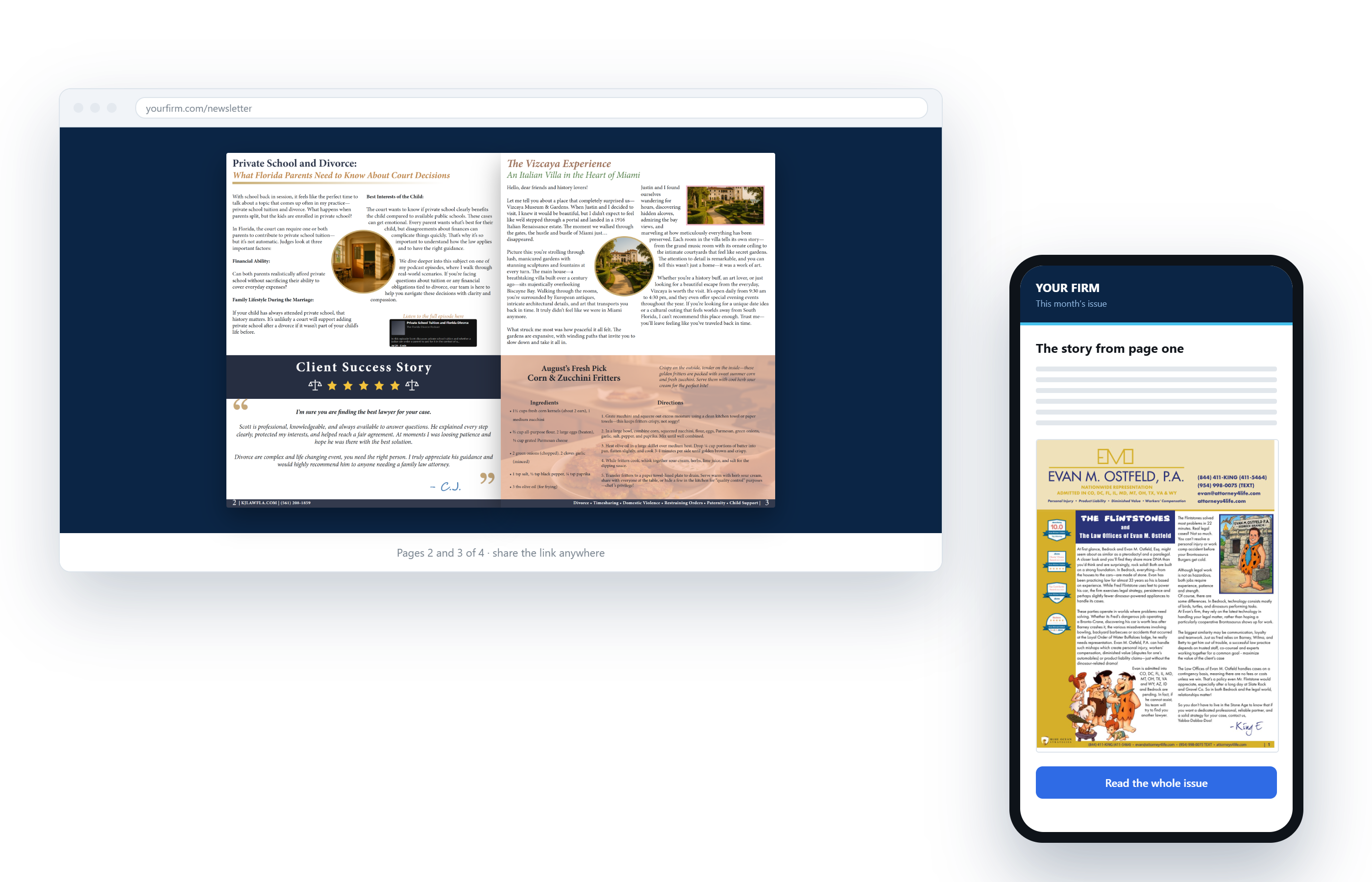
Every issue is set to your own masthead, logo and colors, so it reads as something your firm publishes rather than something a vendor sent on your behalf.
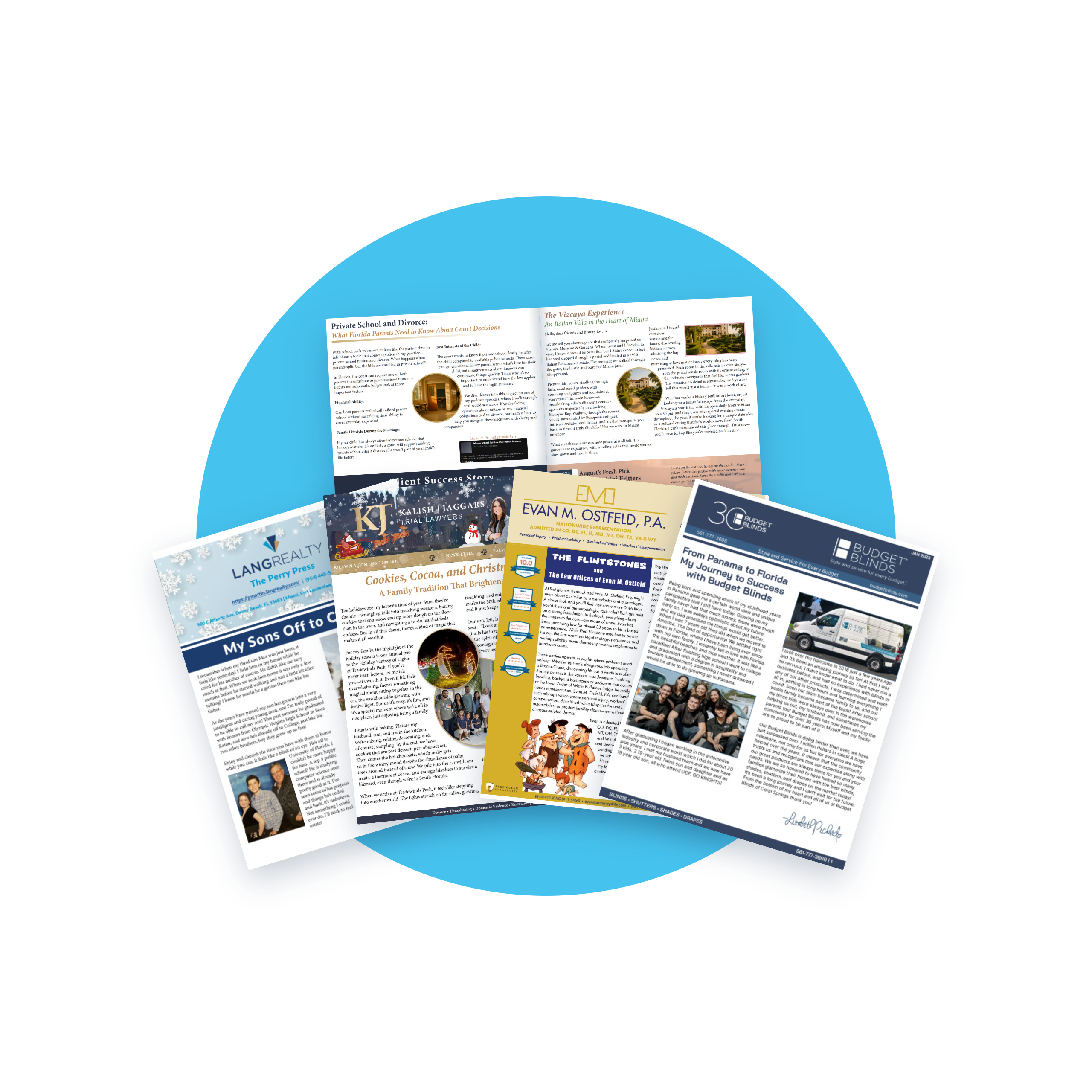
These are real issues that went to print and to a mailing list — a family law firm, a brokerage, a franchise. Any of them can be opened and read end to end in the library.
Ways to buy it
The writing and the design don’t change. What changes is how often it goes out, and whether print follows later.
Twelve issues a year. It’s the cadence that turns into a habit on the reader’s side, and it’s what most clients settle on once the first few are out.
Six issues a year at a lower monthly cost. It works when the list is small or the news genuinely doesn’t move fast enough to fill twelve.
Start with the email and the flipbook and add the printed edition when it’s earning. Nothing gets rebuilt — the printed version comes off the same issue, same cycle.
The alternative
Cheaper is only the right answer when it’s also the right channel for your list.
Questions
Related
Ghostwritten in your voice — print and mail, email and digital, or both.
The one piece clients reply to.Four printed pages, addressed and mailed to your list. Print and postage at cost.
It stays on the desk.Campaigns and sequences that go out on a calendar, not whenever somebody remembers.
Your list, finally working.Send a short note about your business and what is — or isn’t — happening with your marketing. Brandon reads every one and will tell you straight whether we’re a fit.
No pitch deck, no discovery-call gauntlet. One conversation, one straight answer.