
Skip to content

Print & mail

A print newsletter that stays on the desk.

One sheet, folded twice, four sides of writing in your voice, addressed and mailed to your list. You spend about twenty minutes on it. Print and postage are billed to you at cost.

9%

Direct mail to a house list responds at around 9%, against roughly 1% for email to a cold list.

ANA / DMA Response Rate Report
5–25×

Winning a new client costs many times what keeping an existing one does.

Harvard Business Review
77%

of B2B marketers use email newsletters as part of their content marketing.

Content Marketing Institute

Published industry benchmarks, not our clients' results. Outcomes vary by market and list — we don’t promise numbers before we’ve seen yours.

What paper does that a file doesn’t

A printed issue lands in a stack of maybe four things, and three of them are bills. It gets picked up, carried to a desk or a kitchen counter, and left there. Nothing has to be unlocked to read it and nothing pushes it down a screen, so it’s still in the room three days later. It isn’t competing with two hundred unread emails, because it isn’t in the same place as them.

The catch is that every copy costs money to make and to move. A wrong address is a piece you printed, folded and posted for nobody, so list hygiene matters more here than it ever does in email. We’d rather mail four hundred people who know you than four thousand who don’t.

What you get

Everything included, listed.

Nothing here is an upsell waiting to happen. This is the scope.

01

One 11x17 sheet, folded twice

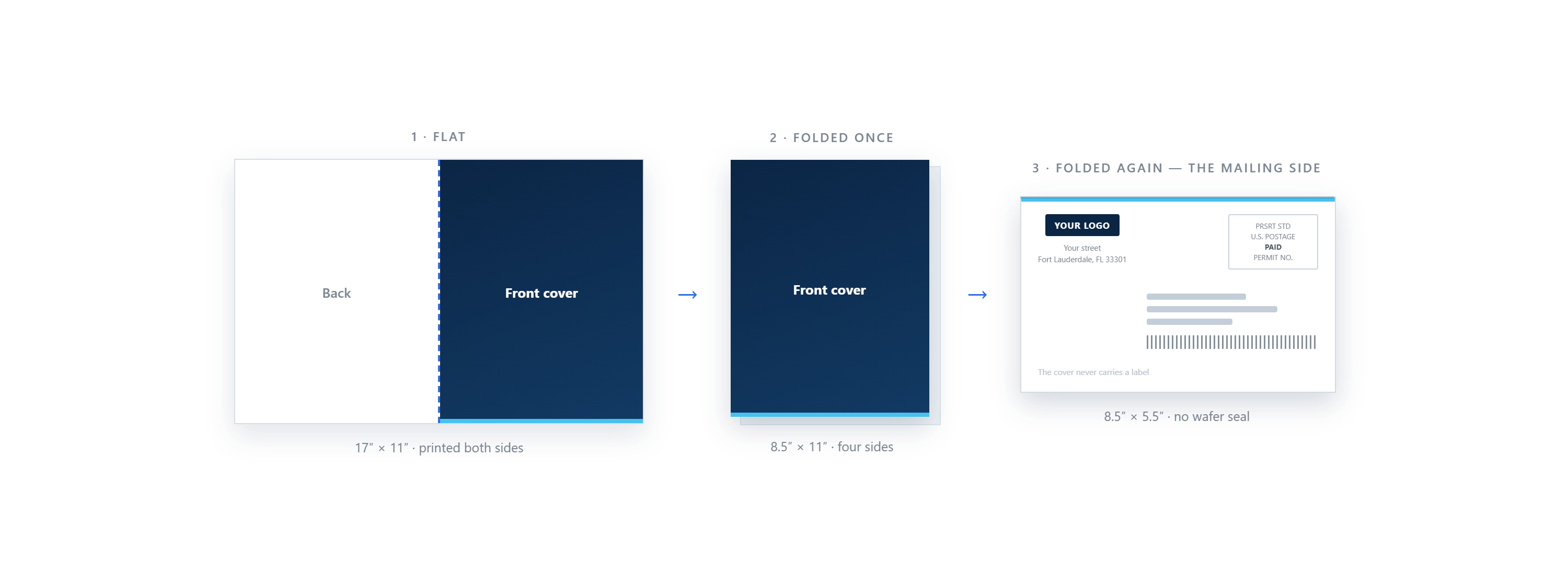
Printed on a single 11x17 sheet, folded to 8.5x11 and folded again to 8.5x5.5 for the mail. Four sides of content, front to back.

02

The mailing panel is part of the design

Return address, postage indicia and the address block are laid out on an outside panel. No wafer seal, and nothing stuck across your cover.

03

Address list prepared before every run

De-duplicated, standardized and checked before it goes to press, because at this stage a bad record is a printed and posted piece nobody reads.

04

Printed through our production partner

Billed to you at cost with the invoice passed straight through. We don’t mark up paper, ink or postage.

05

Mailed under the class you choose

First-Class or Marketing Mail, decided with you before the run and priced out so you know what the difference buys.

06

A proof you sign off

You see all four sides as a PDF and approve it. Nothing goes to press on our say-so.

What arrives

One sheet, folded twice.

The format

It prints on one 11×17 sheet and folds twice — to 8.5×11, then to 8.5×5.5 for mailing. Four sides of space, which is five or six real articles rather than a postcard’s worth of headlines.

The return address, the postage and the address block sit on the outside. Your cover never carries a label, and nothing is stapled or sealed shut.

An 11 by 17 inch sheet flat with a centre fold, folded once to 8.5 by 11, then folded again to 8.5 by 5.5 with the return address, postage indicia and address block on the outside.

What goes inside it

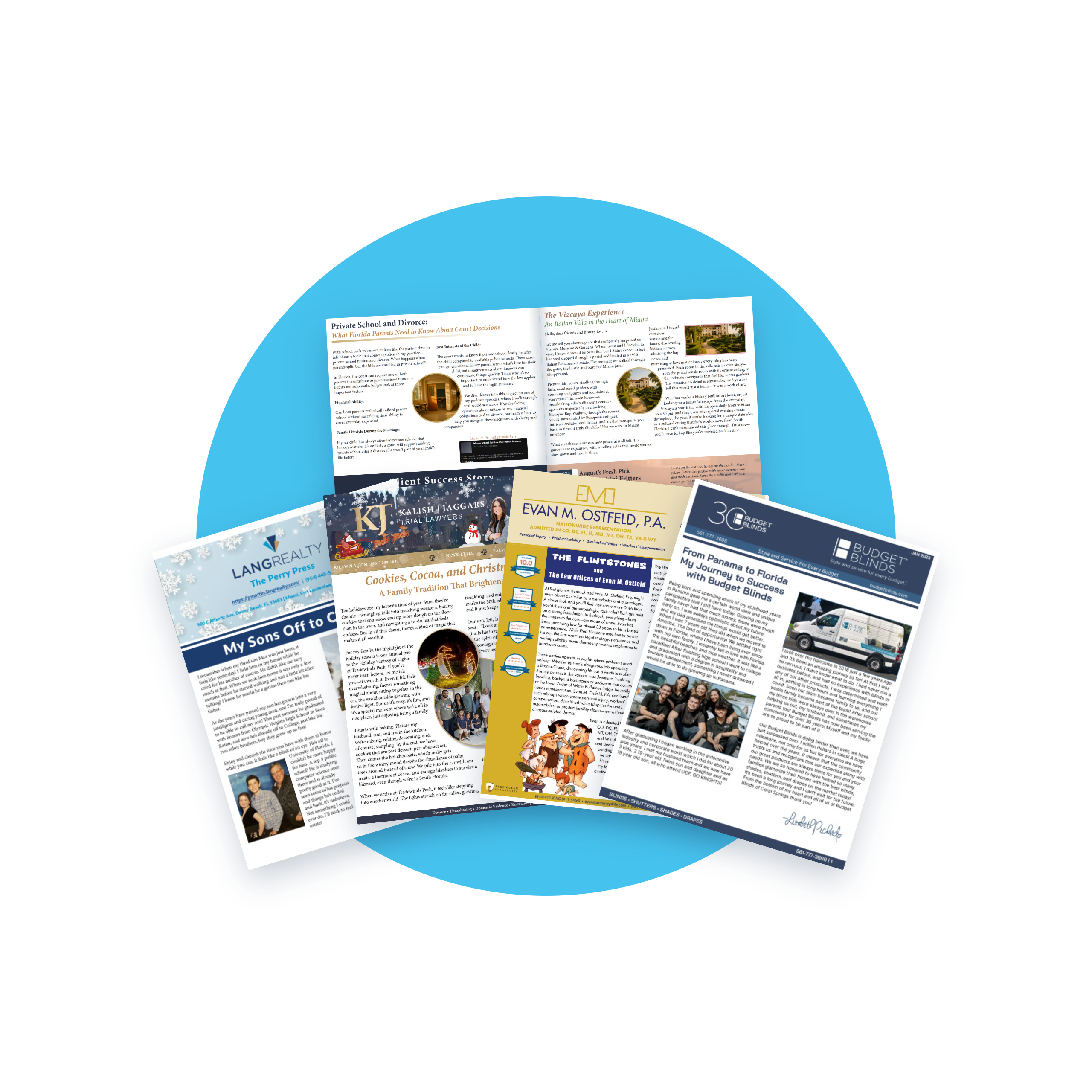
Every issue is set to your own masthead, logo and colors, so it reads as something your firm publishes rather than something a vendor sent on your behalf.

These are real issues that went to print and to a mailing list — a family law firm, a brokerage, a franchise. Any of them can be opened and read end to end in the library.

Four published newsletter covers fanned out, with one issue open to its inside spread.

Ways to buy it

Two ways to put it in the mail

The writing, the design and the print run are identical either way. What changes is the class it mails at, how fast it lands, and what it costs a piece.

Faster

First-Class

About 78 cents a piece metered at 2026 rates. It moves quickly, and presorted First-Class needs a minimum of 500 pieces — under that you mail at the retail rate. This is the one to take when the issue is time-sensitive or the list changes often.

Cheaper

Marketing Mail

About 46.7 cents a piece presorted at 2026 rates, with a 200-piece minimum. The trade is speed — it takes longer to land, so it suits an issue that isn’t dated and a list you’ve cleaned recently. Check current USPS rates before you budget a year of it.

The alternative

Who print earns its cost for

It costs more per contact than email. That’s worth it for some lists and not for others.

Print is the right call when

  • Your list is clients, referral sources and people who’ve met you.
  • A good share of it is older, or sits in a professional office all day.
  • You want whoever else opens the mail to see it — a spouse, a partner, a receptionist.
  • You’d rather reach fewer people properly than more people cheaply.
  • Your postal addresses are good and your email addresses are patchy.

Take the email edition instead when

  • Your contacts are B2B and live in an inbox all day.
  • You want it read the day it ships rather than the following week.
  • You only hold email addresses for most of the list.
  • You want to start cheaper and add print once it’s earning.

Questions

The things people ask before they sign.

Tell us what you need.

Send a short note about your business and what is — or isn’t — happening with your marketing. Brandon reads every one and will tell you straight whether we’re a fit.

No pitch deck, no discovery-call gauntlet. One conversation, one straight answer.

See the workBook a call